
 Contact:+86 02589681215
 Email:xincheng@nju.edu.cn
 Biography
Born in 1985. Associate professor in School of Astronomy and Space Science, Nanjing University, member of Chinese Astronomy Society and American Geophysical Union, reviewer of main scientific journals in astronomy and space science including Science, ApJ, Solar Physics, JGR, RAA et al. I received PhD degree in astronomy in 2012, visited George Mason University as jointed PhD student from 2010.9 to 2011.12 and Max Planck Institute for Solar System Research as Humboldtian from 2019.2 to 2019.8. My main study interests include coronal mass ejections, magnetic reconnection, solar radio bursts, space weather prediction, and stellar mass eruptions et al. I received AGU Basu Early Career Award in Sun-Earth systems science in 2013, Chinese Astronomy Society 5th "Huang Shu-Shu" Award in 2015, NFSC Award for Excellent Yong Scholars and NFSC Award of Jiangsu Province for Distinguished Yong Scholars in 2017.
 Teaching
Introduction of Space Physics (for junior)
chap1_Introduction, chap2_plasma_picture, chap3_single_particle, chap4_Magnetohydrostatics, chap4_MHD_application, chap5_wave,
chap6_solar_eruptions, chap6_solar_atmosphere, chap6_solar_instruments, chap8_magnetosphere, chap7_solarwind, chap9_Summary
Hot Topics in Astronomy and Astrophysics (for junior)
IDL-Python Application in Astronomy and Space Science (for freshman)
 Research Interests
Study Fields: Solar Physics and Space Science
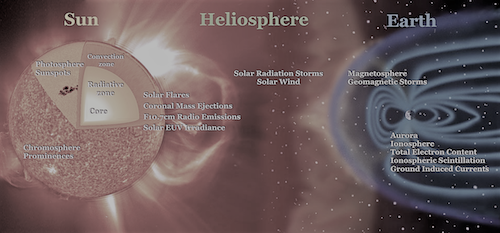
---Understanding Energetic Eruptions in the Heliosphere and Beyond
Visited Scientists、Useful Links、Useful Tools
Papers for new PhD students、Papers on Reconnection
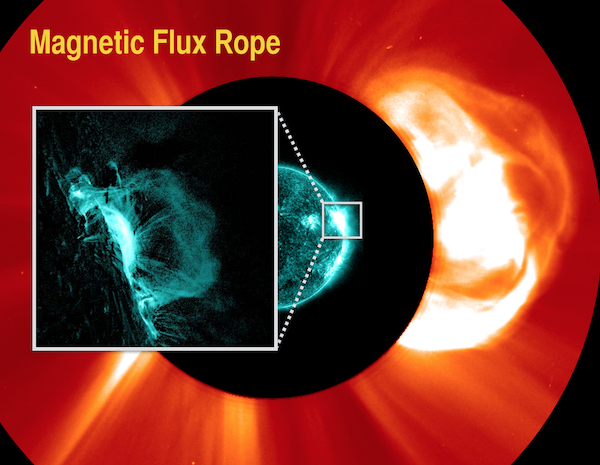
Project 1. Origin and Evolution of Coronal Mass Ejections
Coronal mass ejections (CMEs) and solar flares are the most energetic eruptive phenomena in our solar system and can release a large quantity of plasma and magnetic flux from the solar atmosphere into the solar wind, probably giving rise to severe space weather effects. The aim of this project is toward understanding the orgin and early evolution of CMEs/flares through multi-wavelength observational perspective. The figure on the right shows a CME observed by the Large Angle and Spectrometric Coronagraph on board the Solar and Heliospheric Observatory. The zoom-in of the flaring region indicated by the white box shows an erupting hot magnetic flux rope (10 million-degree) at 131 angstrom
Publications:
Cheng, X., Zhang, J., Liu, Y., Ding, M. D, 2011, ApJL 732, L25
Zhang, J., Cheng, X Ding, M. D., 2012 Nature Communications 3, 747 (Featured)
Cheng, X., Zhang, J., Ding, M. D., et al., 2013, ApJ 763, 43
Cheng, X., Ding, M. D., Guo, Y., et al., 2014, ApJ 780, 28
Cheng, X., Ding, M. D., 2016, ApJS 225, 16
Zhou, Z. J. Cheng, X., Liu, L. J., et al. 2019, ApJL, 877, L28
Cheng, X., Zhang, J., Kliem, B., Torok, T., et al. 2020, ApJ, 894, 85
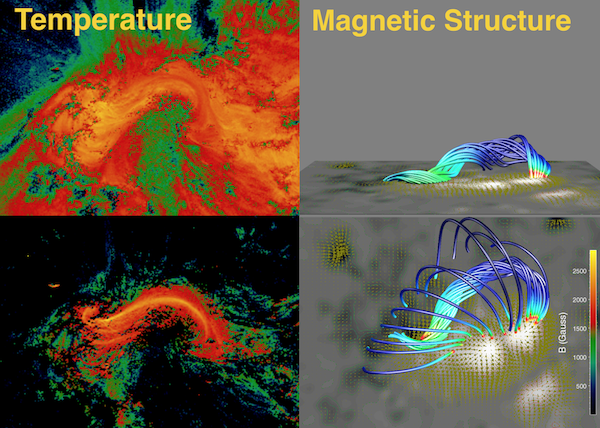
Project 2. Formation of Magnetic Flux Rope
In the solar corona, due to high conductivity, the plasma is frozen to magnetic field, the configurations and dynamics of magnetic field therefore controll the structures and motion behavior of the plasma. The aim of this project is to address the flux rope formation through investigating 3D structures and thermodynamics of pre-eruptive configurations and different components of CMEs/flares in terms of extrapolation technologies and differential emission measure methods. The figure on the right shows the emission distributions at the different temperature range (3-4 MK and 8-10 MK) and corresponding 3D magnetic structure for a pre-existing flux rope on 2012 July 12.
Publications:
Cheng, X., Zhang, J., Saar, S. H., Ding, M. D., 2012, ApJ 761, 62
Cheng, X., Ding, M. D., Zhang, J., et al. 2014, ApJ 789, 93
Cheng, X., Ding, M. D., Fang, C., 2015, ApJ 804, 82
Liu, L. J., Cheng, X., Wang, Y. M., et al. 2018, ApJL, 867, L5
Liu, L. J., Cheng, X., Wang, Y. M., et al. 2019, ApJ, 884, 45
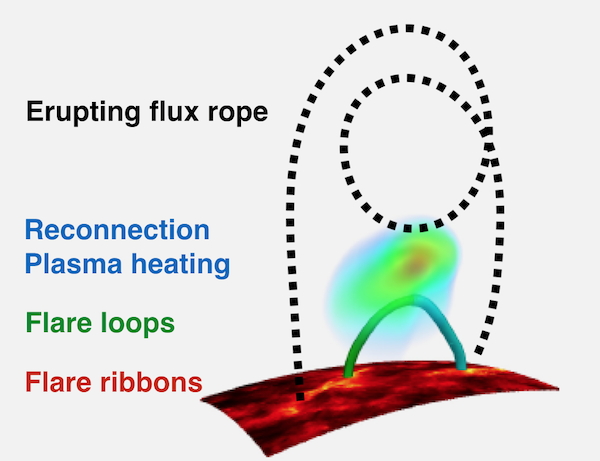
Project 3. 3D Features and Evolution of Magnetic Reconnection
Magnetic reconnection, a change of magnetic field connectivity, is a fundamental physical process in the Universe. During solar eruptions, the reconnection, taking place between CMEs and flares, releases magnetic energy explosively to power the CME eruption and the flare emission. Owing to three-dimensionality of erupting structures and magnetic environments, the reconnection will present a 3D evolution process. The aim of this project is to reveal 3D features and evolution of magnetic reconnection during CMEs/flares. The figure on the right displays 3D magnetic field structures during the flux rope eruption, in which the reconnection converts two sheared overlying field lines to a flare loop and a twisted field line that is added to the pre-existing rising flux rope.
Publications:
Cheng, X., Zhang, J., Liu, Y., Ding, M. D, 2011, ApJL 732, L25
Sun, J. Q., Cheng, X., Ding, M. D., et al., 2015, Nature Communications 6, 7598 (Featured)
Cheng, X., Li, Y., Wan, L. F., et al., 2018, ApJ 866, 64 (Press release)
Xing, C., Cheng, X., Qiu, J., et al., 2020, ApJ 889, 129
Xing, C., Cheng, X., Ding, M. D., 2020, The Innovation, in press
Project 4. Coronal Shocks and Solar Radio Bursts
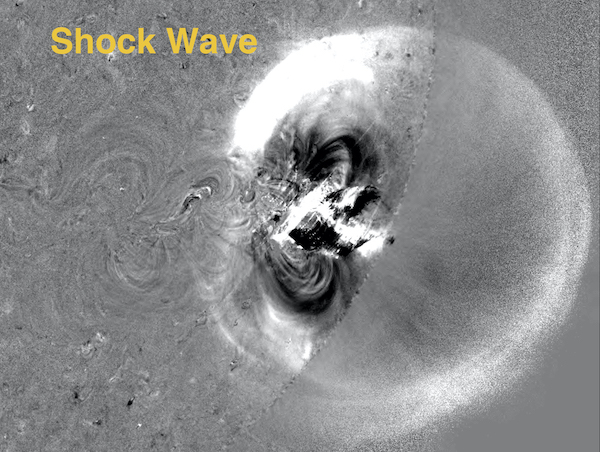
As CMEs erupt upward, coronal shocks may form at the front of the CMEs, generaging metric type II radio bursts, a narrow-band radio emission enhancement excited at the local plasma frequency. On the other hand, eletron beams, accelerated in the reconnection region, produce type III radio bursts simultaneously. At present, the questions of how coronal shocks are formed, what properties do they have, and what conditions do they need to generate type II/III radio emissions remain. This project involves various ground-based solar radio observations such as MUSER and space-based missions. The figure on the right represents a coronal shock wave driven by the erupting CME. The outermost bright front indicates the shock front, followed by a bright sheath region.
Publications:
Cheng, X., Zhang, J., Olmedo, O., et al., 2012, ApJL 745, L5
Su, W., Cheng, X., Ding, M. D., et al., 2015, ApJ 804, 88
Su, W., Cheng, X., Ding, M. D., et al., 2016, ApJ 830, 70
Wan, L., Cheng, X., Shi, T., Su, W., Ding, M. D., 2016, ApJ 826, 174
Kou, Y. K., Jing, Z. C., Cheng, X., et al. 2020, ApJL, 898, 24
Project 5. Predicting Arrival of Coronal Mass Ejections
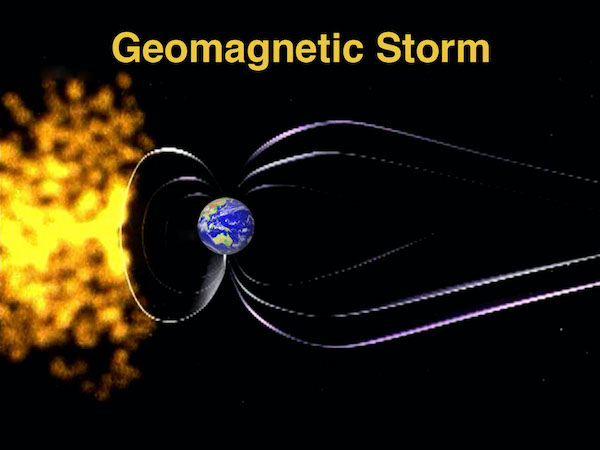
After experiencing a propagation phase of 1-3 days, CMEs may arrive at the Earth and take the from of magnetic clounds with the features of rotation of magnetic field, increased solar wind speed, depressed proton temperature, and low plasma beta. Due to the interaction with the magnetosphere and ionosphere, geomagnetic stroms probably take place, seriously impacting on the safety of high-tech activities in outer space, such as disrupting communications, presenting a hazard to astronauts and so on. In this project, the aim is to predict arrival time of CMEs taking advantage of kinematical models and initial parameters. The figure on the right shows a cartoon of a magnetic cloud interacting with the magnetosphere.
Publications:
Shi, T., Wang, Y., Wan, L., Cheng, X., Ding, M., Zhang, J., 2015, ApJ 806, 271
Current Group Members
Post-Doc:
Yulei Wang (王雨雷) 2020
PhD Students:
Zhuofei Li (李卓霏) 2020
Haitang Li (李海堂) 2020
Chen Xing (邢 晨) 2018
Master Students:
Ziwen Huang (黄紫雯) 2018
Previous Students
Wei Su (2012, Co-supervisor, Graduated in 2015, Postdoc in HUST)
Jianqing Sun (2012, Co-supervisor, Graduated in 2017, Research Scientist in Philips)
Linfeng Wan (2015, Graduated in 2018, PhD student in UCSC)
 Publications
Full Publications: ADS or Google Scholar
Selected Publications:
9. Cheng, X.*; Zhang, J.; Kliem, B.; Torok, T.; Xing, C.; Zhou, Z. J.; Inhester, B.; Ding, M. D., Initiation and Early Kinematic Evolution of Solar Eruptions, ApJ 2020, 894, 85
8. Cheng, X.*; Li, Y.; Wan, L. F.; Ding, M. D.; Chen, P. F.; Zhang, J.; Liu, J. J., Observations of Turbulent Magnetic Reconnection within a Solar Current Sheet, ApJ 2018, 866, 64.
7. Cheng, X.*; Ding, M. D.; Fang, C., Imaging and Spectroscopic Diagnostics on the Formation of Two Magnetic Flux Ropes Revealed by SDO/AIA and IRIS. ApJ 2015, 804, 82.
6. Sun, J. Q.; Cheng, X.*; Ding, M. D.; Guo, Y.; Priest, E. R.; Parnell, C. E.; Edwards, S. J.; Zhang, J.; Chen, P. F.; Fang, C., Extreme ultraviolet imaging of three-dimensional magnetic reconnection in a solar eruption. Nature Communications 2015, 6, 7598.
5. Cheng, X.*; Ding, M. D.; Zhang, J.; Sun, X. D.; Guo, Y.; Wang, Y. M.; Kliem, B.; Deng, Y. Y., Formation of a Double-decker Magnetic Flux Rope in the Sigmoidal Solar Active Region 11520.ApJ 2014, 789, 93.
4. Cheng, X.*; Zhang, J.; Ding, M. D.; Liu, Y.; Poomvises, W., The Driver of Coronal Mass Ejections in the Low Corona: A Flux Rope. ApJ 2013, 763, 43.
3. Zhang, J.; Cheng, X.; Ding, M. D., Observation of an evolving magnetic flux rope before and during a solar eruption. Nature Communications 2012, 3, 747.
2. Cheng, X.; Zhang, J.; Saar, S. H.; Ding, M. D., Differential Emission Measure Analysis of Multiple Structural Components of Coronal Mass Ejections in the Inner Corona. ApJ 2012, 761, 62.
1. Cheng, X.; Zhang, J.; Liu, Y.; Ding, M. D., Observing Flux Rope Formation During the Impulsive Phase of a Solar Eruption. ApJL 2011, 732, 25.